01 / sovereignty
Sovereign by default
Each institution hosts its own node: its data, its applications, optionally its own models. It runs with commercial AI, with local AI, or with no generative AI at all — including offline.
Education 2.0 Conference · Singapore · 2–4 December 2026
Act locally. Share ethically. Think globally. — always with the learner at the centre.
Athena AI Hub is an open, federated and evolving ecosystem. Every institution or stakeholder can deploy its own infrastructure, create its own nodes, and freely choose to connect them to the network.
This network is not imposed by a central platform: it emerges gradually from collaboration, from shared resources and from the exchanges between its members.
Like the Internet, everyone acts locally and keeps control of their own data and their own choices, while contributing to knowledge shared on a global scale.
No centre, by design. Touch a node: each one can federate a network of its own.
Nothing is sent or stored — it is drawn in your browser only.
Origin of the project
In a few Geneva schools, teachers began meeting over AI Lunch-Cafés: an hour, a sandwich and one essential question — what does artificial intelligence really change in our profession, in our practice, and in the way we support learners?
What emerged from those conversations was not a new tool to impose. A shared vision took shape instead: exchange experience and resources, but on certain conditions. That every institution keeps control of its infrastructure and its data. That every author remains credited for what they create. That technology stays in the service of education. And above all, that the learner remains at the centre, and never becomes a product.
Athena AI Hub was born of that vision. It seeks to turn it into a concrete, open and federated ecosystem: an infrastructure that can be installed locally, connected freely to other nodes, and that lets each participant act in their own context while contributing to a collective intelligence.
Act locally, share ethically, think globally — always with the learner at the centre.
The architecture
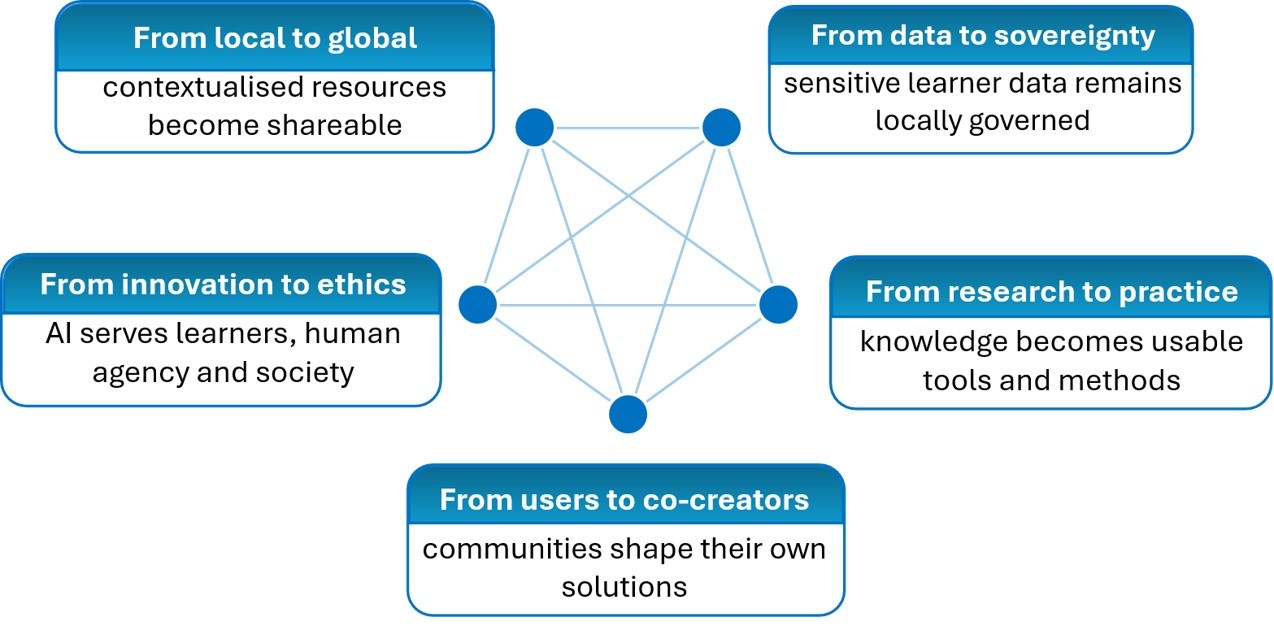
A node is the infrastructure an institution sets up and governs locally. Four fundamental properties define it. They are not negotiable, because they are what keeps the ecosystem ethical, sovereign and centred on the learner.
01 / sovereignty
Each institution hosts its own node: its data, its applications, optionally its own models. It runs with commercial AI, with local AI, or with no generative AI at all — including offline.
02 / provenance
Every resource travels with its attribution, its provenance and the information needed to guarantee its integrity — so the teachers and contributors who designed it remain identifiable, recognised and credited for their work.
03 / portability
Share not only the final resource, but also the process, the context and the choices that produced it — so that a stakeholder in another culture, another language or another educational context can understand it, adapt it and develop it further, while keeping the trace of its origin and its transformations.
04 / the invariant
Every technical, economic or political choice must be justifiable by its benefit or safety for the learner. Version 1 exchanges resources between teachers only: no learner data is transmitted.
State of the project
Athena AI Hub brings together an already defined educational, technical, governance and economic framework, supported by reference components and practical use cases that are progressively implemented and tested.
Maturity scale: defined → prototyped → implemented → tested → piloted → validated → operational. Each component carries the stage it has actually reached, not the one it is heading for.
What does not exist yet is the network itself. A network is not something one institution can build alone.
Our aim in Singapore is to show it in five minutes: a resource published on one node, discovered from a second, adapted through the Composable Context Stack, and a new version traced back to its origin.
Version 1 exchanges resources between teachers only. No learner data is transmitted.
Meet us there
Three days bringing together educators, innovators and policymakers from around the world, under the theme The Great Education Reboot. The programme runs from redefining teaching models and integrating AI to inclusivity, creativity and lifelong learning.
In Dubai and Las Vegas we shared a philosophy and a direction. In Singapore we would like to show what happens once that philosophy becomes an architecture — and to hear what it would take for your institution to set up a node. If it helps, we can support you through it, from the first discussion to deploying your own infrastructure.
The project is carried by
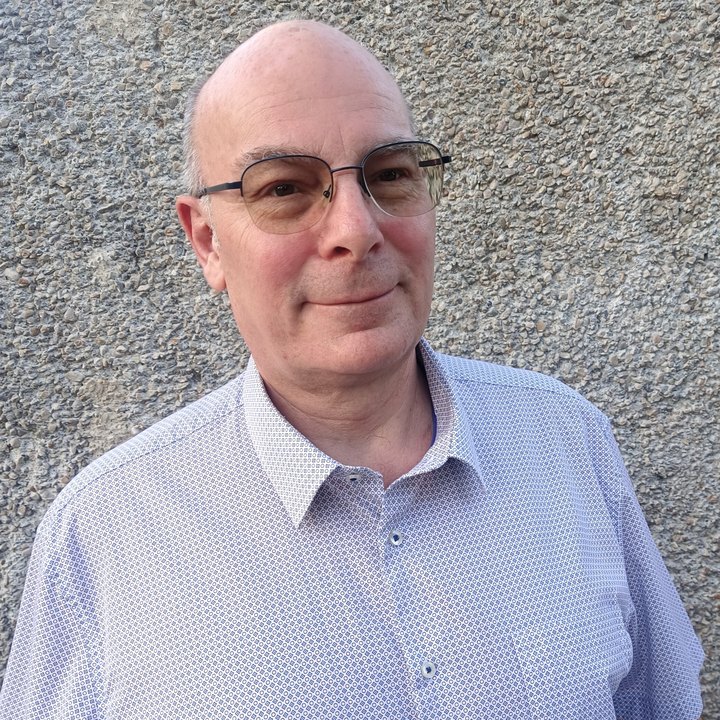
President, AI4Ed · Board Member, Swiss Informatics Society
Johann Sievering is a Swiss computer scientist working at the crossroads of artificial intelligence and education. He holds a PhD in Computer Science from the University of Geneva, where his research addressed software agents and dynamic knowledge representation.
His work sits between scientific research and the reality of the classroom: teaching, software development, and the design of learning environments where practitioners can experiment with AI.
At the heart of this work lies a central principle: technology must remain in the service of people and of society.
He advocates an artificial intelligence that is learner-centred, ethical, inclusive, collaborative, and respectful of human agency and data sovereignty.
Act locally, share ethically, think globally — always with the learner at the centre.
Switzerland's national association of informatics professionals. Since 1983 it has connected academia, industry, public institutions and education to advance digital competence, responsible innovation and a sustainable digital society.
The SI interest group dedicated to artificial intelligence in education. It coordinates the co-creation of responsible AI practices for teaching and learning across institutions, and is the neutral home of the Athena commons.
Get in touch
Would you like to set up a node, contribute to the specification, or simply follow how Athena AI Hub develops? Write to us. Every message is read by a person, and every message helps the project evolve.